Distance sampling: Theory and applications
Free course on the fundamental ideas behind estimating species density from transect surveys, for wildlife conservationists, researchers and teaching staff
distance-sampling
beginner
theory
- Learn with us for free!
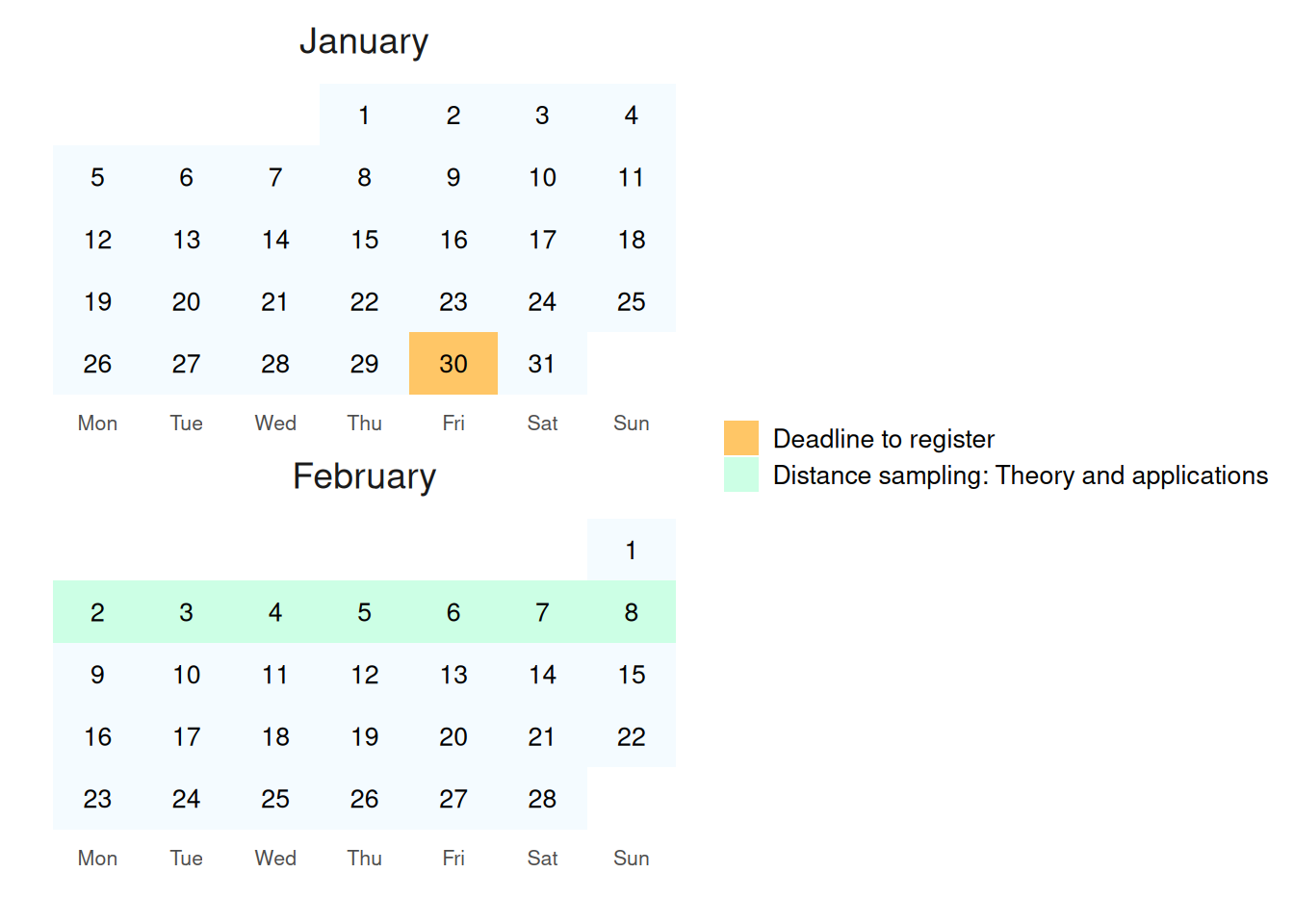
- 3-6 hours study during the week of 02 February 2026
- Strengthen the science behind your conservation action or research
- Gain a confident grasp of the theory behind distance sampling
- Connect with conservationists working on similar projects across the globe
Ensuring your conservation action is based on sound science requires a wealth of technical skills. Is this technique right for you?
You might want to learn the fundamentals of Distance sampling because:
- ✅ Your research supervisor recommends distance sampling for collecting and analysing field data
- ✋ You’ve started a new role or are applying for a job that requires an understanding of population monitoring
- 📖 You’ve heard of distance sampling at a conference or in scientific papers, and are curious to learn if it could be useful for you
We know it can be overwhelming when you need to learn a new technique 😓
We’re here to help!
About the course
Our online course Distance sampling: Theory and applications dives into the ideas behind distance sampling
You’ll find this course useful if you need to:
- 👍 Decide whether distance sampling will help you enhance your conservation work
- 💬 Understand and contribute to discussions amongst colleagues or collaborators who are using distance sampling
- 😄 Gain confidence in applying monitoring methods where detection of species varies across time and space
- 🧑🎓 Teach wildlife monitoring techniques as part of your job in university, government agencies or NGOs
- 🤓 Demonstrate your grasp of population monitoring theory and applications
Our course is ideal for you if you’re a complete beginner to distance sampling, or if you want to remind yourself how this powerful technique works, and how it can be used in conservation
Learning objectives
By the end of this course you will be able to:
- Propose ways in which distance sampling can be applied in conservation
- Define detectability, encounter rate and density
- Explain the principles behind distance sampling
- State the assumptions of distance sampling
- Suggest reasons for lack of detection, or variability in detection
Related courses
We have two follow-on courses on Distance sampling running in February/March 2026, which require an understanding of the theory:
- Survey design - suitable if you’re planning a project which requires you to estimate species density/population size and the factors that affect it
- Analysis with R - suitable if you already have wildlife sightings from transects or point counts and need to gain insights from them
This Theory & applications course is a pre-requisite for our other Distance sampling courses!
If you’re unsure which course is suitable for you, we recommend you register for this Theory & applications course. You can decide during this course whether to continue with either or both the Survey design or Analysis courses
We are also happy to give you individual advice on choosing a course - do contact us if you’d like guidance
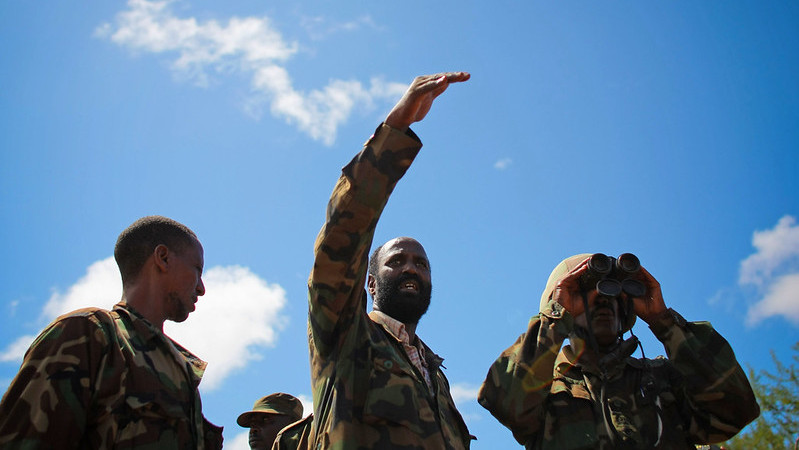
Understanding the theory that underlies these powerful analytical techniques is vital for using them effectively, and making the most of the scarce financial and human resources available for conservation

Dr Lucy Tallents, Founder and Director of VerdantLearn
Register for the course
You can request to join the course on VerdantLearn’s community site:
ℹ️ You will need to create a login for the community before you can request to join the course
Course dates
This one-week tutored course starts on Mon 02 February 2026 and ends on Sun 08 February 2026
Study time is 3-6 hours. The timing is completely flexible - you can participate whenever it suits you during the week
Course fees and discounts
This course is completely free!
Simply request to join:
- Visit our community’s page for course participants
- Click the ‘Request’ button (top-right)
- Add your reason for wanting to study the course
- Make sure your community profile includes information on your conservation work or aspirations, so we can quickly review and approve your request
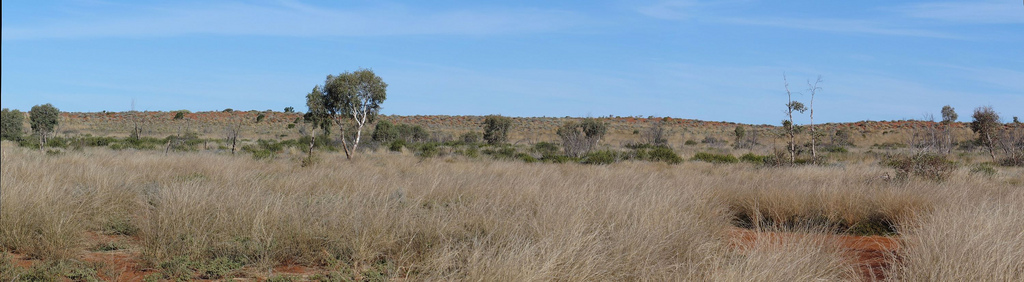
[The course] enabled us to see that it was something feasible that will help us with difficult things … it was [no longer] something mysterious for us
Student on GIS for wildlife conservation beginner course
Any questions?
Visit our Frequently Asked Questions, or contact us
So, are you eager to learn how distance sampling could enhance your conservation work…?
Join our mail-list to stay informed about future courses, events and resources